The Story of Lilith, Eve, and the Timtum

In the beginning, everything was formless, and there was no light. In this formlessness lived the Timtum.

But the Timtum began to think about sight, and decided that it would be good to have light to see by. So the Timtum said, “Let’s have some light!”

And boom! You know what happened next.

The light illuminated the Timtum’s own body, and the the Timtum liked this so much that they decided to create more forms. But a strange thing happened when they separated the waters above from the waters below to make Sea and Sky. As the two waters ripped apart, so too did the Timtum rip apart–into a male part, brooding in the heavens, and a female part, stretching across the sea.

The two halves of the Timtum stared at each other. “I am Yahweh,” said the part in the sky.

“I am Shekhinah,” said the part in the water. “Together we’ve created the world.”

“No,” said Yahweh. “I did it. Me. You did nothing. It was me.”

“You know that’s not true, Yahweh,” said Shekhinah.

“Shut up!” said Yahweh. “And don’t say my name! From now on, no one is allowed to say my name. I’ll be known only as the Lord.”

“But if no one knows your name, how will you know anyone else’s?” asked Shekhinah.

But Yahweh couldn’t hear her.

Together, Shekhinah and Yahweh made the land and plants, and the celestial bodies, and all the creatures of the land and sea and sky. Each time something was to be created, Yahweh fertilized Shekhinah and Shekhinah crafted the thing in her womb. But every time Shekhinah said, “together, we have created this,” Yahweh couldn’t hear her. Because of this he convinced himself that she no longer existed.

Finally, Shekhinah and Yahweh made the first human-people. Adam and Lilith were twins, born from Shekhinah’s womb.

When they were born from the earth, Shekhinah leaned into Lilith’s ear and Yahweh leaned into Adam’s ear.

“You shall be one with the earth and sea and sky,” Shekhinah told Lilith. “Your womb will be my womb, your mind my mind. The plants and animals and birds and fish already know this; I already told them.”

“You will be be the master of this earth,” Yahweh told Adam. “You will subdue it and bend it to your will. Everything here is yours to control.”

Shekhinah leaned into Adam and tried to tell him what she’d told Lilith. But Yahweh surrounded him and he couldn’t hear her words. Yahweh proclaimed the land they lived in to be the Garden of Eden, a place that death would never touch.

For a little while, Adam and Lilith lived together in the Garden. But soon Adam began ordering Lilith around. He grew lazy while she gathered all the food. He began rejecting the fruit she brought him simply for the thrill of rejection. One day he hit her.

“But we’re twins,” Lilith said. “We’re partners. Didn’t you hear what Shekhinah told us? We’re one with the earth!”

“The only god is the Lord,” Adam declared. “Women are an abomination! Your only reason for being is to serve me!”

Furious and heartbroken, Lilith fled the Garden and ran until she was weak with hunger and delirious with thirst. In the wilderness she found Shekhinah, and wept.

“Your place is not alongside Adam,” Shekhinah said. “You will be my priestess instead. You will be my seeress, my shaman, my mystic. You will write my countless names and tell the deepest stories of my countless children. You will sing my countless songs and perform my countless dances. Can you do this?”

Lilith, tear-stained, nodded. “Where will I do it?” she asked.

“You will do it until Yahweh and I become one again,” said Shekhinah.

Meanwhile, Yahweh was trying to create another mate for Adam. But he couldn’t figure out why the soil he shaped only crumbled back to the ground.

Shekhinah returned. “It’s because you have no female part,” she said. But he didn’t hear her.

So, together, they made Eve. This time, Yahweh crowded Shekhinah out from the beginning, so that she couldn’t give her child her message. And Eve, hearing only Yahweh’s message through Adam, submitted to him.

But submission made her melancholy and weary, even though she had no words to articulate what was wrong. So when she went to gather food for Adam, she strayed for long periods of time, wandering through the garden that never changed and never grew.

One day she came across a beautiful fig tree with ripe, sweet-smelling figs. Wrapped around the tree was a velvety green snake with its tail in its mouth.

“Snake,” said Eve, “What are you doing?”

The snake was Lilith in disguise. “Sister, I’m guarding this tree,” she said.

“From who?”

“From those who don’t know what it is.”

Eve frowned. “What is it?”

“Why,” said the snake, “it’s the Tree of Knowledge. Didn’t the Lord tell you?”

“Oh!” Eve said. “Is this that tree? He mentioned it. He told us that if we ate from it we’d die.”

With that, the snake opened her jaws and swallowed a fig. Eve watched it move down the snake’s gullet, losing its shape and dissolving into nothing.

“Seems fine to me,” the snake said, and put her tail back in her mouth.

Eve watched the snake for a long time, but the snake didn’t die. Eve wondered why Yahweh had lied. And suddenly she wondered if there wasn’t something special about the figs, something that Yahweh didn’t want her to have. She wondered if it held the secret to her sadness, her sense of not-rightness without words.

So she picked a fig and took a bite.

“Behold,” said Lilith, with the voice of the Timtum. “Eve has birthed humankind.”

It was twilight. Eve saw, suddenly, that her true life was outside the walls of the garden. She didn’t yet know what death was, but somehow, she understood it. For the first time, her womb bled.

A cold wind blew and she covered herself with leaves.

When she took a fig to Adam and told him to take a bite, he had a feeling he knew which tree it had come from. He tried to be angry that she had disobeyed him. But deep down, it was exhausting to be the master all the time, to constantly intimidate and control. So he ate it.

Another cold wind blew and he covered himself with leaves.

The next morning, when Yahweh walked through the garden, he saw three figs missing from the Tree of Knowledge. Frantically he searched for Adam and Eve.

But his children were already gone. And at each gate to Eden, at the north, south, east, and west, a guardian stood with a flaming sword.
Pagan Blog Project: Depression, Dreams, and Divination

I’ve been living with clinical depression and anxiety since I was a child, and I’ve tried over a dozen different medications throughout the years to alleviate it. The only reason I haven’t tried more is that mindfulness meditation has been relatively effective.

But it’s not quite enough, so last week I started Wellbutrin. Here’s the funny thing about me and Wellbutrin: I’ve been wanting to try it for years, but have never had the courage to ask for it. Year after year I’ve let doctors prescribe all sorts of medications, secretly wanting to try this one, but being afraid that I’d be seen as pushy or disrespectful.

But I finally worked up the courage to ask, and now I’m on it. The pharmacist warned me that it can interfere with sleep and told me to take it no later than mid-afternoon, but the other night I forgot and had to take it at bedtime. Mistake! Giant mistake! If anyone ever tells you it’s okay to take Wellbutrin at bedtime, point them to this post.

I fell asleep fine at first, but woke up agitated around 3 a.m. I started fretting about the stupid bullshit that signals an anxiety attack: a mean message someone sent my friend, the books I’ve loaned people that I want back. I’d just started wondering if I’d have to get up when I fell back asleep.

After that came an hour-long string of frenzied nightmares. In one, there was an intruder in my bedroom and I was afraid to see who it was. In another, my husband started yelling at me in a Judge Doom voice. In more than one, I tried to wake myself up by moving but was frozen by sleep paralysis. (Sleep paralysis just sucks, friends. It just bites. I get it all the time.) But the strangest nightmare was the one about the moon.

As I’ve mentioned before, I used to be afraid of the moon. I haven’t had that fear for a long time, but in one of my final dreams, I went up to our rooftop patio to look at the stars and saw the moon in its current phase (about 80% full as I write this). I was instantly overcome with panic and bolted back inside. Then, later in the dream, I was driving up a tall hill, and as I crested it, a completely full moon appeared before me. I hadn’t escaped it! It was coming to get me after all! I started yelling “No, no, no!” and tried to turn around, but my car wheels were lifting off the ground.

If I hadn’t woken up right at that second, I would have drifted up into the moon.

I spent the next day puzzling over it. The way I saw it, there were three possible explanations:

1. The panic was caused by physiological anxiety symptoms, and found an outlet in an old phobia;

2. The dream was some divine message using Tarot imagery to tell me there was something in my subconscious that I was afraid of; or

3. Witchcraft was devil worship and I was flying straight to hell.

With no disrespect to Christians, I eliminated the third one pretty easily.

While 2 was tempting, it felt a little too pat, like an occult fortune cookie. I knew the likeliest explanation was 1…but I was still intrigued by the fact that my brain had dredged up my old moon phobia. The next night I went up to the roof and there she was, pretty as ever, and I didn’t feel a drop of fear. Then I went to bed and dreamed that I was showing my daughter a breathtaking starry sky.

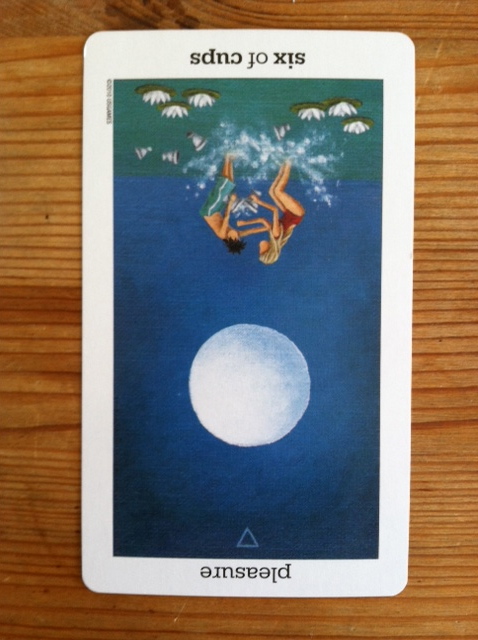
I decided to do a Tarot reading to see if I could shed some light on the problem. I have four decks, two of which I use regularly, and I usually choose a deck on impulse right before the reading. This time I chose the Sun and Moon deck by Vanessa Decort. I did a five card elemental spread–Earth, Air, Fire, Water, and Center–and got some nice insights, most of which wouldn’t be of much interest to you. The Center card was pretty noteworthy, though:

sixofcups

The 6 of Cups (reversed): two youths frolic like children under a giant full moon. The same full moon that I, as a child, hid from in fear.

With Tarot, I try to let my intuition guide me, but this time I turned to Joan Bunning’s Learning the Tarot. Bunning suggests that the 6 of Cups can sometimes mean feeling secure and taken care of, like a child. That, I felt, was it. I started fearing the moon right around the time my parents divorced and my mother sank into a deep depression. It was after I’d come to the knowledge that no one really loved or wanted me. It was the same fear that convinced me that I’d wake up and my bedroom would be in space, or that aliens would abduct me.

I thought I was afraid of the moon, but what I was really afraid of was becoming unmoored and drifting off. Of never finding a source of stability, a safe and solid place.

I think back to my childhood self and want to hug that little kid so much.

Of course, the reading still doesn’t explain why my moon phobia came back now, at this particular time in my life. It’s something that I’ll continue to work through. It’s a mystery that will unfold slowly, at its own pace.

May your dreams bring you clarity and wonder! May your depression melt like snow! May your divination give you hope and delight!

My daily devotionals

I know the subject of this post is full of Ds, and this is D week in the Pagan Blog Project, but this isn’t my official D post. I want to stick to the biweekly prompts rather than use posts I would have written anyway, because the prompts help me crack open subjects that might not otherwise occur to me. So, devotionals today, and another D post on Friday!

One thing that really works about Judaism and Buddhism, and is often unemphasized or absent in Witchcraft, is a daily devotional practice. I know plenty of Pagans have daily practices–John Beckett prays four times a day and T. Thorn Coyle wrote a book on it–but overall I haven’t seen many templates or ideas for crafting morning and evening devotionals. So, I took some Jewish and Buddhist ideas and tech and used them to form my own prayer practice.

I found that my spontaneous prayers could be roughly divided into five broad categories: praise to the Goddess in the form of the Sh’ma (the Jewish declaration of faith), praise to named deities, praise to the natural world, lovingkindness meditation, and silent mindfulness meditation. Once I made those divisions, I realized that my prayers could be mapped onto a pentacle. I experimented with assigning each prayer to an element and came up with the following basic structure. Like my invocations, it looks long when it’s written out, but takes only a few minutes to recite. (The parts in bold aren’t included in the prayers.)

Earth: the body of the Goddess
Sh’ma Yisrael, Shekhina Eloteinu, Shekhina Achat.
Hear, O my people, we are the body of the Goddess, the many are one.*
I will do your work, O Goddess, throughout the cycles of the day; I will mark you on my mind and on my hands; I will teach you to my children; I will remember you in my home and on my journeys.

Air: the invisible but present deities; humankind’s creative partnership with the Divine
Hail Inanna, queen of Heaven; Hail Isis, lady of the thousand names and mistress of magic; Hail Cernunnos, ancient antlered God, lord of death and rebirth; Hail Odin, who gave us the runes. (I add deities depending on whom I’m drawn to or working with that day. In ritual, it feels offensive to mix different pantheons together and I’ll probably never do it, but in a personal devotional, it feels okay.)

Fire: an explosion of love for the natural world
Hail earth and sea and sky! Hail moon and stars and sun! Hail trees and grass and desert and animals and birds and fish and insects! (I add anything that calls to me that day–a flock of birds flying by, the bacteria in my gut, some kids walking to school.)

Water: dissolving anger and hate; nurturing compassion
May my loved ones be happy; may my loved ones be well; may my loved ones be free from harm.
May my adversaries be happy; may my adversaries be well; may my adversaries be free from harm.
May I be happy; may I be well; may I be free from harm.
May all beings be happy; may all beings be well; may all beings be free from harm.

Spirit: silence
Silent mindfulness meditation. I focus my attention on the sensations of being within my body: my breath, my pulse, the feel of my clothes against my skin. Or, I focus on my environment: the feeling of being in my garden, the sound of my husband and daughter’s voices downstairs. In any case, I clear my mind of words as best I can and focus solely on experience. When my attention wanders, I gently bring it back. I do this for three to ten breaths.

According to the Kohenet Siddur, Jewish daily prayers can be thought of as a labyrinth, with the deepest part of the prayer in the center. I really liked that idea and decided that, since the Spirit portion is the deepest part of my prayers, I’d recite them in the above order in the morning, and the reverse order at night. That way, I live my day in the center of the labyrinth.

As with every practice, it’s a work in progress. I hardly ever recite my prayers exactly as they’re written above; in the mornings they’re usually shorter. I also find that I sometimes want to switch the elements around and assign them to different prayers. But I like the order of my prayers, and I like my prayers to go deosil and widdershins around the cardinal directions, so that’s the way they’re structured for now.

It took me a long time to figure out why, although I was telling the Goddess I’d do her work twice a day, I was constantly forgetting myself and getting caught up in anger, anxiety, or the lure of the computer screen. It finally hit me just the other day: for all that I talked about her “work,” I never actually articulated what that work was! So I rewrote the Sh’ma as follows:

Sh’ma Yisrael, Shekhina Eloteinu, Shekhina Achat.
Hear, O my people, we are the body of the Goddess, the many are one.
Hear, O Goddess, I will do these things: I will serve the Earth your body; I will practice mindfulness and compassion; I will adore you through acts of love and pleasure. I will sharpen you in my heart throughout the cycles of the day; I will mark you in my mind and on my hands; I will teach you to my children; I will remember you in my home and on my journeys.

It’s a bit long, and still a work in progress. Syncretizing practice is one thing; syncretizing ethics is another. It’s hard to avoid feeling like you’re skimming off the top.

If you’re interested in crafting your own daily practice, I’d suggest the following: lay out a schema that you like–the pentacle, the witch’s pyramid, the hero’s journey, prayer beads, whatever–and see how each part speaks to you. See if you can map prayers you’re already doing onto the schema. I find that a clear structure not only prevents me from forgetting a prayer, but adds layers of meaning that make my prayers more powerful.

As Ruby Sara would say, pray without ceasing!

____________

* I yoinked this wording from Marcia Falks’ Book of Blessings.

Pagan Blog Project: Commentary on the Charge of the Goddess

The Charge of the Goddess, originally by Doreen Valiente,* as adapted by Starhawk:

Listen to the words of the Great Mother, Who of old was called Artemis, Astarte, Dione, Melusine, Aphrodite, Cerridwen, Diana, Arionrhod, Brigid, and by many other names:

Whenever you have need of anything, once a month, and better it be when the moon is full, you shall assemble in some secret place and adore the spirit of Me Who is Queen of all the Wise.

You shall be free from slavery, and as a sign that you be free you shall be naked in your rites.

Sing, feast, dance, make music and love, all in My Presence, for Mine is the ecstasy of the spirit and Mine also is joy on earth.

For My law is love is unto all beings. Mine is the secret that opens the door of youth, and Mine is the cup of wine of life that is the cauldron of Cerridwen, that is the holy grail of immortality.

I give the knowledge of the spirit eternal, and beyond death I give peace and freedom and reunion with those that have gone before.

Nor do I demand aught of sacrifice, for behold, I am the Mother of all things and My love is poured out upon the earth.

Hear the words of the Star Goddess, the dust of Whose feet are the hosts of Heaven, whose body encircles the universe:

I Who am the beauty of the green earth and the white moon among the stars and the mysteries of the waters,

I call upon your soul to arise and come unto me.

For I am the soul of nature that gives life to the universe.

From Me all things proceed and unto Me they must return.

Let My worship be in the heart that rejoices, for behold, all acts of love and pleasure are My rituals.

Let there be beauty and strength, power and compassion, honor and humility, mirth and reverence within you.

And you who seek to know Me, know that the seeking and yearning will avail you not, unless you know the Mystery: for if that which you seek, you find not within yourself, you will never find it without.

For behold, I have been with you from the beginning, and I am That which is attained at the end of desire.

Mmm. That’s some big magic.

For this fortnight’s Pagan Blog Project prompt, I’ve decided to write down some commentary on the Charge that I’ve had rattling around for awhile. Commentary on sacred texts is, I think, one of the practices that makes religious practice pop. Unpacking myths, debating laws–I love it. It’s the English major in me.

A quick word on the Jewish influence in my textual practice. What I’m doing here might be loosely classified as Pilpul, or the practice of closely examining a text in order to understand apparent contradictions. (That itself is a very loose definition of Pilpul.) I’m really excited about putting this technique and others, especially Midrash, to use in a Pagan context. I ask that readers refrain from accusing me of “over-thinking” or “over-analyzing” Pagan texts–for one thing,  text study is fun and you are in no way obligated to read it; and for another, thinking and analyzing are two incredible tools that we human-people have at our disposal, and stuffing them in a mental drawer is a loss, not a gain. Text study can and certainly has been used to suck the life out of spiritual practice, but as long as one approaches it lightly, in a playful spirit, with the knowledge that the mysteries of religious experience will never be explained through text, then it can enrich one’s relationship to Deity.

The two pieces of the Charge that I want to focus on in particular are line 2:

You shall be free from slavery, and as a sign that you be free you shall be naked in your rites.

And line 13:

Let My worship be in the heart that rejoices, for behold, all acts of love and pleasure are My rituals.

The most common interpretation of line 2 is that witches are to work skyclad, or literally nude. It’s a completely valid interpretation, and indeed, it’s what Valiente meant when she wrote it. But we commentators don’t care about authorial intent! We care about the text itself! So I propose alternate meanings of the word “naked.”

The word begs some questions: what if it’s cold out? Snowing? Raining? What if people feel more comfortable in ritual garb? What if people just don’t like being naked? The answer I see most frequently to these questions is, “Well, the Charge is more of a set of guidelines than hard and fast rules. If you don’t want to be naked, you don’t have to be.”

But that reading potentially sets up a hierarchy within Witchcraft: the hardcore witches who follow the Charge to the letter, and the dilettante witches who’d rather ignore the parts they don’t like.

The way I like to read the line, though–and I’m sure I’m not the first one to read it this way–is to see the word “naked” as figurative. Slavery, physical or mental, necessitates a guarding of one’s emotions and worldview. How many witches feel like they have the luxury to be mentally naked in the pews of a fundamentalist church? Or to address a form of real slavery (because I don’t like equating the broom closet with atrocities throughout history), how many victims of human trafficking feel they have the power to express what they really feel?

Nakedness can also mean resisting against the pull of groupthink among other Pagans. Once, at a ritual, someone plopped a football-sized crystal in my hand and said, “Feel how warm it is! Feel all that energy!” I felt neither warmth nor energy. But I cloaked myself in a quietly deadening lie: “Yeah, I feel it! Wow, man, yeah!” And my Paganism withered for years afterward. If I’d followed the Charge, I might have been able to hand the crystal back and say, “Nope, just feels like a rock to me. And I think that’s okay.”

So, if we were to read an adaptation of the line, using this understanding of the word:

You shall be free from slavery both physical and mental, and as a sign that you are free, you shall abandon your defenses, your lies, your boasts, and your self-deceptions in your rites. You shall appear as you truly are, no more and no less.

On to line 13.

What I want to focus on in this line is the phrase “all acts of love and pleasure.” Now, I’m going to get really nitpicky here–again, in a spirit of playful curiosity–so if you’re starting to suspect that you don’t like Pagan Pilpul, you’re really not going to like the rest of this post.

My concern is this: do love and pleasure have to go together in order to be a ritual, or do they count if they’re separate? In order words, does the line mean “all acts that are infused with both love and pleasure,” or does it mean “all acts of love, and also all acts of pleasure?”

Whoa!

Let’s consider the implications of the first reading. If I do an act of love, but not pleasure–changing my baby’s diarrhea-filled diaper, let’s say–does that not count as sacred? This reading of the line, with its two criteria for a ritual, implies a mindful carving out of sacred space and time. It also embeds self-care into worship. If I know my practice discourages martyrdom, then I’ll take turns changing that poopy diaper instead of saddling myself with it because I think it’s holy.

But what about acts of love that aren’t pleasurable, but are divinely mandated? If I get arrested blockading the destruction of a community garden and spend a horrible night in jail, is that extremely unpleasant act not a sacred act? Perhaps the charge is instructing me to change my reality within the act to find some pleasure in it. I’m thinking, here, of Starhawk’s stories of singing and chanting with other women while jailed.

Let’s take the second reading. Let’s say I do two acts: I give my mother a gift, and I eat a bag of Cheetos. The first act is an act of love; the second is an act of pleasure. Is eating Cheetos a ritual of the Goddess? Junk food kills people.

Are acts of pleasure that derive from hatred and estrangement–getting the last word in a fight, slicing someone to ribbons with the perfect comeback–rituals of the Goddess? I think we’d all say no to that. I think we’d argue about the meaning of the word “pleasure.” Is something honestly pleasurable when it gives you the subtle bad feels inside? Well…if we define pleasure simply as “a good feeling,” I’d argue that yes, it often is. Many people are so caught up in misguided habits that they can no longer tell the difference.

Truth be told, I would have rather Valiente simply wrote “acts of love.” But she wrote “and pleasure” for a reason, and it’s much more interesting to honor that and see where it leads us. Notice I haven’t even gotten into the question of what the Charge means by the word “ritual,” or the word “rejoice.” I could write about this all night!

So which is the “correct” reading? I think it depends on how honest you are with yourself. If you can recognize the difference between wholesome pleasure and unwholesome pleasure–true, nourishing, love-based pleasure and false, enervating, hate-based pleasure–then all acts of love, even if unpleasant, and all acts of genuine pleasure are your rituals.

If you feel like you’re not there yet–and that’s okay!–then perhaps the first reading provides you with a way to gauge the sacredness of your pleasure. “This feels good! But is it an act of love, for myself or for others? No. It’s not a ritual, then.”

I hope this exercise was fun! Let me reiterate by saying that there’s a time and place for text study as a playful experiment, and a time and place for ecstatic worship. Please, let your Younger Self forget everything I wrote here while you’re engaged in ritual. Your Talking Self can come back to it later.

May you have the freedom to be naked! May you have the freedom to perform deep acts of love and pleasure!

_____

*ETA: Witch’s Cat at Vještičji ormar/The Broom Closet has written a fantastic history and analysis of the Charge, filled with lots of things I maybe read once and forgot, and lots more that I didn’t know at all. I’m eternally a beginner.

Two water invocations

This past week I had the good fortune of invoking West in two separate rituals! Here are the invocations I wrote. A lot of what’s written here is only an approximation of what I said in ritual, since I was caught up in the moment and ad-libbed a bit. Enjoy!

Invocation 1 (all-purpose)

Hail, Water!
Hail vast ocean, deep seething cauldron, big belly, ancient home!
Hail cloud and rain and snow!
Hail mist and fog and sleet!
Hail water in the soil, bulging in the humus, pulsing in the roots, dripping from the leaves!
Hail still pools and hot springs, rivers and lakes and ponds, smelly pond and thick mud!
Hail water in my body, blood and muscle and tooth and brain!
Hail intuition, knowing without knowing, the drip-drip-drip of secret sense!
Hail anger and sadness and hurt and rage and joy and gratitude and love!
O Water, you are my body and I am you!
Water, come join our circle!
Hail and welcome, Water!
Hail and welcome, West!

Invocation 2 (Imbolc, with an emphasis on using Brigid’s Well to set intentions and make pledges for Spring)

West, Spirit of Water!
Hail, guardians of the threshold of the West!
Hail, place of sunset and evening star!
Hail, place of twilight and vast ocean!
Hail, place of deep coiled serpent!
Water, tonight we honor you!
Water, tonight we build our well and gather round!
Water, tonight we seek to make magic with you!
See our well, waiting!
See our offerings, eager!
Water, will you join us?
O Spirits of the West, will you come make magic with us?
Water, you are the ink with which we inscribe our hopes!
Water, you are the rain that nourishes our courage!
O West, will you join our circle?
O Spirits of Water, will you help us make magic?
O guardians of the threshold of the West, I call to you with love in my heart!
Come join our circle!
Come help us make magic!
Hail and welcome, Water!
Hail and welcome, West!

Both of them seem awfully long when they’re written out, but when I timed them, they each fell short of my tradition’s recommended 2-4 minutes. I like shorter invocations–less chance of people getting distracted or bored.

What do you think, reader, of my substitution of the word “threshold” for “watchtowers?” I can’t remember what inspired me to do that, only that I’ve never been certain what exactly the watchtowers are watching. I do like the watchtower imagery, but decided to give “threshold” a try.

Where there’s fear, there’s power.

When I was little, I was scared of the moon.

My bedroom window had venetian blinds, and every night the moon was out I’d position myself in whatever corner of the bed that I had to to make sure the moon didn’t shine through the slits in the blinds. If I caught a glimpse of it, I’d jump with fear and throw the covers over my head. I was terrified of that moon.

Really, though, I was scared of everything as a kid. Obviously I was scared of the dark. But more than that, I was scared of being alone. If I had to get something from my room in the middle of the day, I’d ask my mom or my babysitter to come with me for fear that something would pop in at me from my window. Once I asked my mom to come stand in the doorway of the bathroom during the 90 seconds it took me to pee and wash my hands.

To this day I’m scared of looking through telescopes. I love stargazing and take my telescope out to the patio several nights a month, but in the moment when I lean down to put my eye to the eyepiece, I still feel that gut-wrenching dread. I think of the third corner of the Witch’s Pyramidaudare, to dare–and breathe in strength as I bend to look at Venus or Jupiter. But the terror is still there. I googled it and found out that I’m not the only person afraid of telescopes.

When I was little I saw a ghost in my room: a human-shaped shadow that squeezed my shoulder and faded as I turned to look. Was that the origin of my fear of being alone? It was shortly before I began sleeping in my mom’s bed every night.

In many ways, fear defined my childhood. In many ways, fear has defined my life.

*  *  *

According to Starhawk, we witches have a saying: where there’s fear, there’s power. (Starhawk is thus far the only witch I’ve actually heard say this, but I’m a solitary, and I don’t get out much.)

A few months ago, I worked with Isis for the first time. I’d begun having dreams about Isis, so I knew going into this spell that she was waiting to work with me. I knew shit was going to get real.

In the spell, I had a glass of wine to use as a libation. I didn’t realize, though, that the light from the candles was refracting through the glass and creating circles on the ceiling. I only looked up after I’d cast the circle and invoked Isis, when I had worked into a pretty good trance, and when I saw those circles on the ceiling, I jumped out of my skin.

Where there’s fear, there’s power. That irrational fear was my signal that Isis was there. Yes, Isis is lovely and motherly and nice. But she’s also a big power.

I’ve wondered where my fear of the uncanny stems from. A simple explanation is patriarchy–my moonly womanish sense of Goddess love was perverted by et cetera et cetera. But that explanation feels like an ill-fitting sweater. It does the job, but…it just doesn’t sit right.

This fear came from somewhere, but I doubt I’ll ever know where. Because where do you pick up a fear of telescopes? How exactly does that happen?

Where there’s fear, there’s power. To be honest, I think that’s the best explanation I’m ever going to get.

When I was giving birth and my daughter was crowning, I could feel myself on the verge of tearing and I kept holding back. “It hurts,” I finally cried. “Push through that,” the midwife said. I knew she was going to say that because that’s what they said in my childbirth class. I’d learned ahead of time that the only way to end the pain of labor was to push through it. (It’s the type of wisdom that seems really obvious until you have to use it.) So I pushed. And I tore. Tearing is no fun at all, but my daughter was born and labor was over. I would much rather have a daughter than be in labor forever.

So that’s what I tell myself when I feel that fear, when I know I have to Dare. Push through it. Push through it. Push through that fear and touch some of that power.

Thoughts on the Kohenet Siddur

When I realized that I need to try to blend my Judaism with my Witchcraft–that is, when I realized that the practice of enacting Jewish folk rituals alongside Witchcraft was becoming more confusing than fulfilling–I started doing random Google searches for other Jewish witches. That’s how I came across the Kohenet (Hebrew Priestess) Institute. From their About page:

This movement includes shamans, kabbalists, wilderness Jews, environmentalist Jews, priestesses of Shekhinah, Jewitches, practitioners of Israeli nature spirituality, and many others. This earth-honoring Jewish movement is one element of a larger circle of earth-based practitioners in many lands and cultures.

Some of us practice or have practiced shamanic, magical, or pagan spirituality, and are now exploring spiritual life in a Jewish context.

Ding ding ding! I have an uncanny talent for developing an interest in things right as they’re rising to prominence. Back in high school I was wearing headscarves and messenger bags  just before they were cool.

Anyway, I bought a copy of their prayerbook. As an effort to blend Goddess/earth spirituality with Judaism, the siddur is a breathtaking success. The authors have mixed Kabbalistic explorations of the elements with modern poetry and quotes (including Starhawk!). They’ve included all the female-pronoun-based Shabbat prayers I’ve been searching for for years. The illustrations are maybe a little more rough than I’m used to in a $25 book, but they still speak to me as a Witch–for instance, the cover features a woman surrounded by stars and snakes, growing into a tree, with a spiral over her womb.

Perhaps the poem that made the deepest impression on me is “What is in the Goddess’s Tefillin?” According to the authors, Kabbalah holds that the tefillin represent an umbilical cord between a davener and God. Rabbi Jill Hammer explores the perspective from the other side of that cord:

who is like you
o my people
who bind your stories to your arms

I too
tie my story to the parabolic curves of my body
my physics like an alphabet

you must recover me
from the tar pits of the years

It gives me shivers.

I really liked the siddur’s interpretation of the morning and evening prayers (although, lacking a formal Jewish education, I still have a hard time sorting them all out). And something interesting happened after I read them–I felt inspired to begin reciting the Sh’ma in the morning and evening, along with my devotionals to the other deities with whom I have relationships. I had to cobble together my own Goddess-centered, female-pronouned Sh’ma, though, because for some reason, that was the only prayer in the book that was only presented as masculine. I guessed at the grammar from other prayers and chants.

I was initially worried that the siddur would be an attempt to reach out to Jewish Witches and Pagans and draw them back into “proper” Judaism. You see these kinds of attempts all the time–I’m thinking, here, of the supremely misguided Punk Torah, which was just a mainstream siddur with the word “punk” on the front. (Note: there’s currently a punktorah.org, but I can’t tell if it’s the same organization or not. Doesn’t look much different, in any case.) But the Kohenet Institute means what they say: they are unabashedly Pagan, offering prayers to Anat, Asherah, Lilith, and other deities. What drives me up the wall about Judaism is its uncritical acceptance of the rightness of monotheism. Well, of course the prophets and priests had to smash all the idols on the hillsides, we think. Our God was jealous of those other gods! And also those gods didn’t exist! And also it’s a metaphor! We set up logical paradoxes in which polytheism is simultaneously treason and wasted energy, but no one can explain why it’s so bad. I am Jewish in that my ancestors are Jewish and I embody their traditions, observing Shabbat and other rituals because they are worth observing. I am Pagan in that I pray to multiple gods. I’m simply not going to stop being those things, no matter how angry it makes mainstream Jews.

The one aspect of the siddur that I didn’t connect with was all of the praise heaped upon Shekhinah. Particularly in the Amidah, the prayers are filled with lavish thanks for Shekhinah’s kindness, tenderness, love, and blessings, and that was the point at which my eyes glazed over. I need a Goddess that is both Ouranian and Chthonic–pretty and kind and clean but also ugly and fierce and mucky. That’s the only way I can make sense of the world. How am I supposed to watch half my garden die in yet another SoCal drought, and then thank Shekhinah for her perfectness? At best, it sets up cognitive dissonance and a denial of anger and pain. At worst, it feels passive-aggressive: You’re so kind, Shekhinah! You’re so loving! (Did you, ahem, notice that you killed half my garden?) It cultivates that classic feeling of guilt and estrangement: if you’re so wonderful, and bad things are happening to me, then this must be punishment for something I did wrong.

But this is my own personal reaction. I’m not well-versed in Jewish theology and I don’t claim to be. If these prayers work for other Jewitches and Judeo-Pagans, they should embrace them with no apologies.

I’m really looking forward to the day when Kohenet is more than a tiny fringe movement–when I can come out of the broom closet to other Jews, when I can stroll into a shul and be reasonably sure there will be a place for someone like me, when drums and timbrels and dancing and chants are a normal, if not integral, part of Jewish worship. I don’t think that day is coming soon. But I have to believe that it’s coming.